

4th category — proactive designing
an emerging category of jobs


One of the people that I have admired over the years is Robert Reich, and not just because we share Berkeley. His ideas have influenced my own work over the decades in part because of his insights into the nature of work.
His recent interview on PBS focused on how jobs will be reshaped by AI, listing three categories of jobs for the near future: https://www.pbs.org/newshour/show/how-the-next-wave-of-workers-will-adapt-as-artificial-intelligence-reshapes-jobs
Reich’s three categories are;
1. Making
2. Thinking
3. Caring
A brief explanation of his categories, in his words, states that:
… making jobs really have been automated over
the last 30 to 40 years. You go into a manufacturing
facility today and it's mostly computerized machine
tools.
… thinking jobs are the ones that are most at risk
from artificial intelligence, because artificial
intelligence really will be automated, many thinking
jobs. I'm talking about everything from doctors to
lawyers, accountants, people who are — and call
themselves professionals who have got a lot of
degrees, but whose particular thinking processes can
be replicated and is being replicated by A.I.
… caring jobs, the third category of jobs, the people who provide
personal care, whether it's childcare or eldercare,
nurses, psychotherapists, people who are in the job of,
if you will, empathy, their jobs will not easily be
replaced by A.I. because the essence of caring jobs is
humans, human touch, human contact, human caring.
A.I. may pretend and convince some people that there
is a human being operating on the other side of the
screen, but ultimately human touch is going to be
incredibly important.
Rober Reich
PBS News Hour interview Sept/3/25
Presented here is a 4th category of jobs that is nascent at the moment, waiting for attention and resources to more fully form and be brought into action — proactive designing jobs. This category of work strategies avoids the vulnerabilities to AI that the other three categories possess. The nature of work, thinking, and doing is not some variation of automation or rule-driven activity as defined in this fourth category.
Advancing into more desirable futures is the opposite of retreating from undesirable presents, which is the primary strategy of the three categories presented by Reich.
Education for preparation and participation in this 4th category of jobs is limited at the moment, although there are scholar-practitioners developing frameworks for this new category of work, and even some who are trying out new approaches to praxis in this important and necessary category of work.
Educational or professional preparation for proactive designing requires a particular type of pedagogy to be fully effective — one that connects learning and training to action. Preparation for working in proactive designing is multi-dimensional and systemic. It is a form of learning-for-action rather than just learning and training for knowledge and skill accumulation.
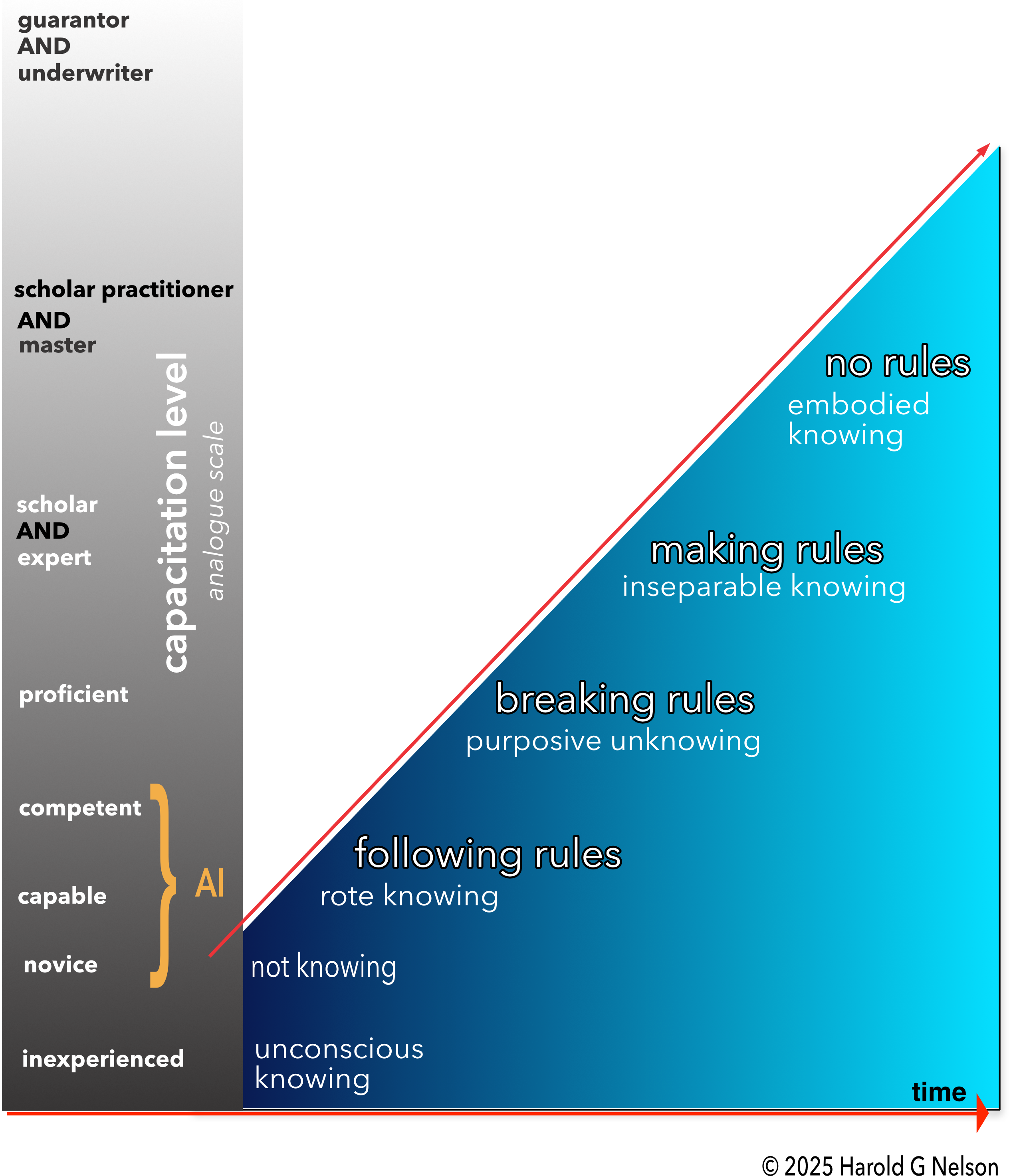
‘Capacitation’ is a process of life-long human-centered learning, progressing through stages and phases of learning and training in competencies and abilities in systemic designing. This is a form of learning that is beyond machine learning and other technical euphemisms for aggregation. AI seems to mimic ‘learning’ for those who do not understand the nature of learning. Machine learning or AI learning is an unfortunate use of a term that ascribes living systems’ behavior to nonliving, technical systems.
The schema below shows a view of an analogue capacitation process over time. The levels where AI has any application or relevance are shown as occurring at the bottom of the analogue ‘capacitation’ scale and at the beginning of the ‘capacitation’ development process.
Proactive systemic designing consists of engaging with:
1. Indeterminacy in addition to determinacy
2. Advancing into desired futures rather than backing away from the present
3. Feed-forward rather than just feedback control systems
4. Judgment integrated with decision making
5. Framing and naming in complex contexts and environments
6. Problem resolving and dissolving rather than only problem solving
7. Setting standards of measurement for desired outcomes
8. Aiming and setting courses of action — intensions
9. Navigating courses of action to reach desired outcomes — intentions
Serving the desires and needs of all stakeholders, including cardinal stakeholders
…
These are just a few of the tactics and strategies that define this 4th category of work. Of course, there is a great deal more to be known related to this category, but despite that, one of the key understandings is that this category is open to using requisite tools like AI in all its multiple manifestations, but this category is not defined by such tools and concomitant methods. The nature of the activities in proactive systemic design determines what tools and methods are appropriate, but tools and methods do not dictate the nature of the work; they only support the work when appropriate to do so in a fitting way.
In my files I have a copy you sent of Chapter 14,"The Three Jobs of the Future" from Reich's Book "The Work of Nations" Published in 1991. The title of Chapter 14 is " The Three Jobs of the Future". In that chapter he states, "Essentially, three broad categories of work are emerging, corresponding to three different competitive positions in which Americans find themselves. The same three categories are taking shape in other nations. Call them routine production services, in person services and symbolic services.
He goes on to focus on the "Symbolic Analyst"..."who is one who engages in problem-solving, problem identifying, and strategic brokering activities. They solve identify and broker problems by manipulating symbols. They simplify reality into abstract images that can be rearranged, jugged, experimented with, communicated to other specialists then eventually transformed back into reality."
In the following chapter he discussed education of the Symbolic Analyst with comments like, "...learn how to conceptualize problems and solutions." and acquiring "..four basic skills: abstraction, system thinking, experimentation and collaboration." with emphasis on judgment and interpretation, using inquiry to become " skeptical, curious and creative."
My point here is this, he seems to nudge the principles of design without ever recognizing or delving into it. Yet he does predict the present situation. But here we are bogged down into the quagmire of properly solving a problem that can't be solved. That requires systemic design(s).