

crucibles
A crucible holds ‘work’ that is dynamic, indeterminate and energetic.

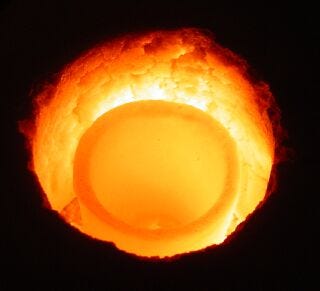
If your ‘work’ is creative, innovative, transformational, metamorphic, transmutational, or evolutionary, it requires a well-formed crucible. If it is imaginative, artistic, inspired, unconventional, or unorthodox, a crucible is necessary. If it is transcendent or spiritual, a crucible is needed.
Crucibles provide character, value, meaning, and direction to your ‘work’. They offer places and shields for enabling the ‘work’.
Crucibles can be either interactive or passive (such as a bowl). A crucible can be a person, a social system, or a physical entity.
Crucibles are created, not found. Crucibles are compositions of terminal and instrumental values. They reify meaning. They support approaches to work such as designs of inquiry and action. Crucibles provide the platform for stances supported by beliefs, understandings, assumptions, and fundamentals – ‘bottom turtles’ – and set a course for intensions and aims.
It is a mystery why ‘work’ crucibles receive so little attention in formal educational programs and in professional practice. It is puzzling that there is so little engagement with learning how to form and maintain crucibles for ‘work’.
I discuss ‘work’ crucibles in this Keynote given at the RSD 14 Conference, October 3, 2025: