

Strategy
aiming systemic design

Strategy
Strategy is a term that is in constant use nowadays, or misuse, as is often the case. Strategy means different things to different people and different kinds of organizations. The variety of understandings and definitions of what strategy is is expansive.
Strategies differ in kind, scale, and purpose. Some strategies are grand. For example, strategies for securing improvement in the human condition. Some strategies are less so, although still of value, such as strategies for selling more goods and services to potential customers. The following discourse advocates for an approach to strategy from a systemic design perspective.
Creating and using strategies is not easy work. Unfortunately, ‘easy buttons’ like AI ‘prompts’ are threatening to replace the hard work of strategizing in an ever-growing number of cases. Strategizing, however, is a very human-centered activity that involves preparing for and taking chosen actions. It requires the engagement of competent strategists.
Strategy is at times misidentified with other approaches to preferred action, such as planning. Roger Martin, a well-known expert on strategy, takes on the long-running issue of confusing strategy with this other approach to action, ascerting that planning is not strategy:
Formal social systems, such as governmental agencies, nonprofits, businesses, and military organizations, say they are interested in learning how to create strategies and employ them in their ongoing practices. The challenge is how and where to start.
The term strategy has been annexed to several domains. In the domain of business, conversations around ‘business strategy’ are common. Similarly, there are a growing number of conversations around ‘strategic planning’ (see Roger Martin’s comments above). Recently, ‘strategic design’ has been a focus of growing interest.
Experts in strategy from these various approaches make the case that strategy is valuable and necessary for the success of any organization’s purpose. The question remains: what do they advise doing?
Of course, there are many reasons and excuses commonly used for avoiding the difficult work of formulating and applying strategies in the real world. Unfortunately, bad habits regarding how to prepare for and take effective action are formed in these strategy-absent vacuums.
urgent action
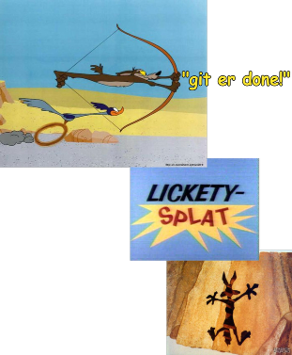
Unlike the logical sequential stages of preparing for the action of a foot race —on your mark, get ready, get set, go — the sequential approach to ‘urgent’ action so popular nowadays — go, ready, aim — leads to inevitable failures more often than not. The example below is only a slightly exaggerated case study.
get ‘er done!
‘Urgent’ action is justified because the case is often made that there is no time, resources, or personnel to take a moment for thoughtful and professional preparation and follow-through that is needed. The default command is to “just get er done!”
Common experiences in organizational life attest to the usual default ‘urgent’ approach to action, which is too often being used in the absence of the will or ability to formulate appropriate strategies and employ them competently. An alternative approach is needed.
Zen archer
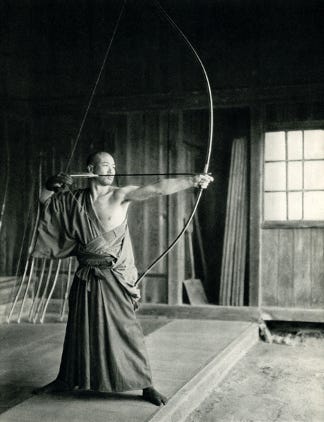
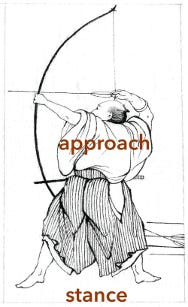
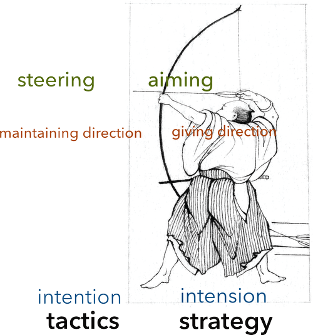
For an alternative, ‘nonurgent’ approach to action, the Zen Archer is a good metaphor for systemic designers in praxis. This metaphor demonstrates the complexity entailed in adequately preparing to take challenging, appropriate action, with follow-through—a systemic stance and approach to systemic design action.
Zen archery is called Kyudo or ‘way of the bow’:
Zen Archer
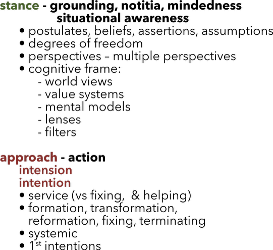
stance and approach.
positioning & action
intension & intention
Taking design action in relation to outcomes that are either: 1) to be determined – i.e., indeterminate intension —or are 2) predetermined — i.e., determinate intention, involves choosing, which is the actual or decided case, and then creating or choosing the right strategies and concomitant tactics for the chosen design challenge.
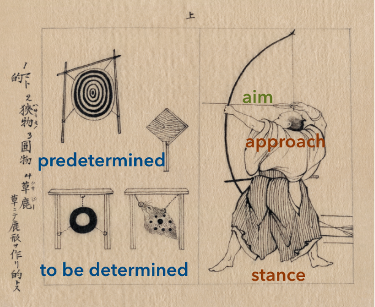
outcomes
Strategic design determines desired outcomes through intension, transforming indeterminate situations into determinate situations that can then be reacted to.
Strategic planning and problem-solving use intention to identify and make visible predetermined or implied outcomes and to utilize appropriate tactics to deal with the given situation.
aiming ‘at’
For tactical designers, planners, and problem-solvers, outcomes are predetermined or determinate. Expanding on the metaphor of a Zen Archer, the design targets in this case are assumed or established in advance. The archer aims in a predetermined direction from a predetermined place. This constitutes aiming at predetermined or implied targets. Tactics are primary in this case.
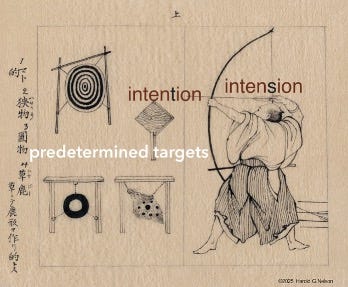
determinate outcomes
For approaches such as planning and problem-solving, the predetermined outcomes – ‘targets’ –are in position and visible, requiring only that the archer aim the bow reactively in their direction. The problem solver or planner takes action from a designated place that is predetermined at a designated time that is predetermined in in relation to predesignated targets.
Aiming for’
Outcomes – ‘targets’ in the Zen archer metaphor – are indeterminate at the beginning for systemic designers and social systems designers, and only revealed once the archer’s intension is made manifest.
For the systemic designer, as a metaphoric archer, the design ‘targets’ — outcomes — are revealed once the bow is brought into tension and aimed in a carefully considered and chosen direction. As a consequence, this action evokes targets that are possibilities or potentials along the chosen course.
The strategic design archer aims for something desirable, such as health, security, progress, education, and well-being, rather than at something like certitude, profit, stature, or security. Both approaches are important within their particular situations. But it is essential to discern which approach is appropriate for any given situation.
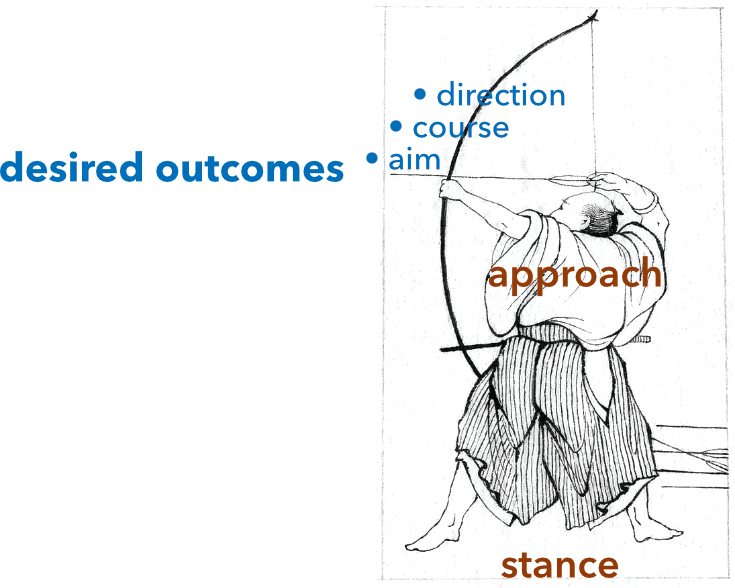
aiming ‘for’
Steering action
In strategic design, the process of aiming for outcomes results in creating desired outcomes to be aimed at, which enables systemic designers to steer their actions towards the desired outcomes. The process of steering involves choosing and using the right tactics and tools for the challenge. Steering, in this case, involves engaging with a cybernetic loop composed of feedforward intentions evoking feedback intentional responses.
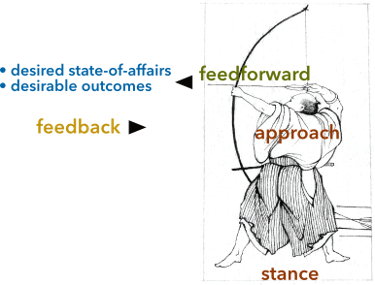
systemic cybernetic loop
strategic action
Strategy is essential to designing because it enables free will to play out. Strategy informs and gives direction for moving towards desirable outcomes of systemic design. This counters the concern of determinists that designers are loose cannons doing whatever they want without a thorough regard for reason and logic. However competent systemic designers are adept at creating the right strategies and concomitant tactics under the influence of free will — or in this case, design will.
Particular or ‘grand’ strategies are brought into situations, while ultimate particular or ‘unique’ strategies are formed within situations to fit particular challenges. Particular strategies are strategies that influence design action over a duration of time and different locations. Ultimate particular strategies fit into a singular time and place for distinct reasons and purposes on behalf of chosen stakeholders.
Is it not so that intension is the motivating desiderata that brings the designer to the point of initially engaging with that which does not yet exist? The designer's mind is stimulated by initial conditions that spark inquiry and imagination. That state of mind becomes a determination to undertake action to achieve the desiderata...a strategy. Following that comes intention, the tactics to enter into a mental and physical state to creatively engage the desiderata as an attractor, toward which the design effort proceeds. Along the way the design process will engage the attractor causing it to be changed into what will eventually become the outcome of the effort to achieve the desiderata.
Agreed. And AI cannot stand in for that particular strange attractor because it cannot communicate with the human mind in that way by imagining that which does not yet exist.